Abstract
Reinforcement learning (RL) from raw sensory inputs such as images or onboard sensors can be challenging due to high-dimensional observations and sparse rewards. A common strategy is to train a teacher policy with access to privileged state information and then distill it into a student policy that acts from raw inputs alone. However, when the teacher relies on information unavailable to the student, exact imitation may be impossible. This creates an irreducible imitation gap. Existing approaches typically mitigate this mismatch through careful reward shaping or additional reinforcement learning on the student policy after the teacher has been trained. Instead, we introduce Representation-Aligned Imitation Learning (RAIL), which addresses the mismatch during teacher training itself. RAIL learns a latent representation shared across teacher and student observations using contrastive learning, and trains the teacher policy directly in this space. Because the teacher policy is constrained to operate on this shared space, it learns behaviors that are reproducible from student observations. This substantially reduces the imitation gap while preserving task performance. Across multiple environments, RAIL outperforms strong baselines without reward modification or post-hoc student fine-tuning, and surpasses direct reinforcement learning from raw observations. The learned representations further enable zero-shot transfer to new tasks through teacher-only training.
Method
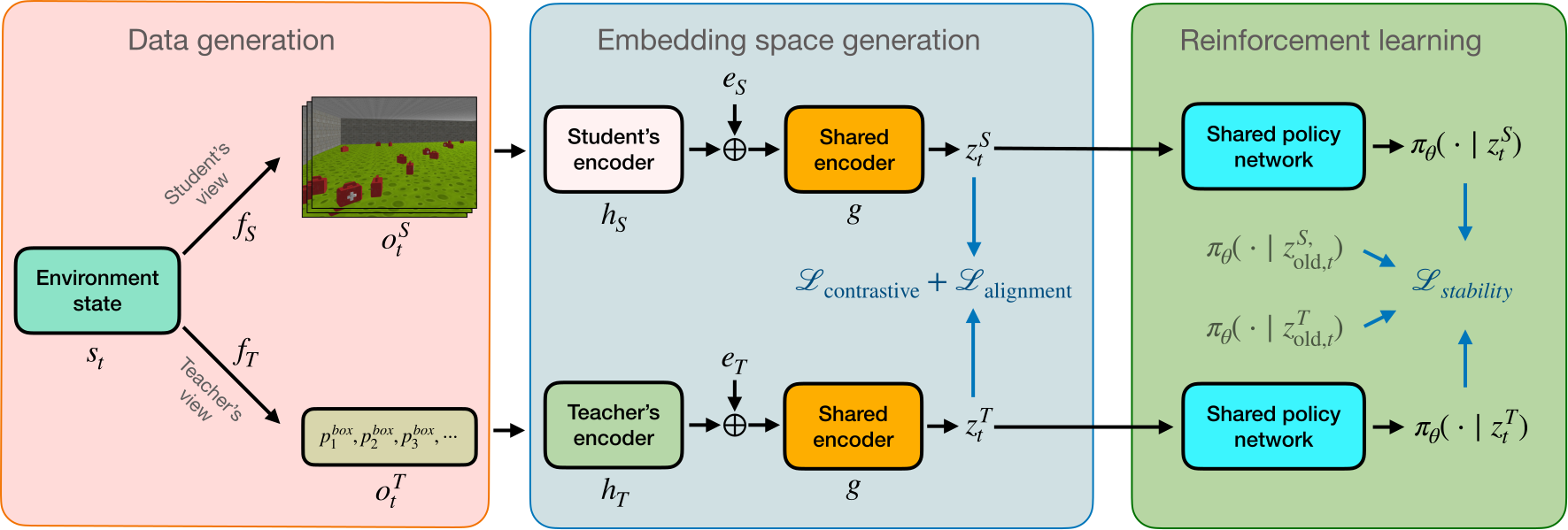
Teacher and student encoders map paired observations from the same environment state into a shared latent space. The encoders are trained using three objectives:
- Contrastive learning encourages the representation to retain information shared by teacher and student while suppressing extra information available only to the teacher. Paired observations are brought together, while observations from different states are separated.
- Alignment brings paired embeddings close enough to support direct policy transfer.
- Stability regularizes changes in policy outputs as the representation evolves.
The shared policy is trained with PPO on teacher embeddings. Policy gradients are stopped at the encoders to limit the encoding of private teacher information. At deployment, the student encoder replaces the teacher encoder.
Experiments
We evaluate RAIL in four simulation environments with asymmetric teacher and student observations. The videos below compare an RL teacher, a behavior cloning (BC) student, a RAIL teacher, and a RAIL student. The RAIL teacher and student use the same policy with their respective encoders.
Teachers trained with RAIL adapt their behavior to the student’s capabilities. By learning to act on shared information, the teacher develops strategies that the student can reproduce from its own observations.
TunnelVision
The agent must reach the goal while avoiding obstacles. The teacher observes all neighboring cells, while the student sees only three cells in its current direction and must turn to discover obstacles.
The RL teacher can avoid obstacles without looking around, but the BC student cannot reliably copy those moves with its limited view. The RAIL teacher learns to turn and check its surroundings, so the student can follow the same route.
Corners
The agent must find a hidden target corner. The teacher knows the target corner, while the student observes only its position and previous action and must search for the target.
The RL teacher knows which corner contains the target and moves straight toward it. The BC student does not know the target location, so it cannot tell which of the teacher’s actions to follow. With RAIL, the teacher learns to search the corners, which the student can do without knowing the target.
CollectHealth
The agent must collect all health boxes while avoiding walls. The teacher receives the relative coordinates of all remaining boxes, while the student acts from five stacked first-person RGB observations with a limited field of view.
The RL teacher heads toward health boxes even when they are outside the student’s view. The student cannot tell where the teacher is headed from its camera images. The RAIL teacher learns to bring boxes into view before it approaches them, so the student can locate them too.
QuarterCheetah
The agent must run forward as fast as possible. The teacher receives joint positions and velocities, while the student acts from third-person RGB observations with the left half of the image removed.
When the RL teacher uses an arbitrary gait, motion in the hidden half of the image cannot reliably be predicted from the visible half. The BC student therefore lacks information needed to reproduce the teacher’s actions. RAIL learns a symmetric gait, so the student can predict the hidden motion from the visible half.
Results
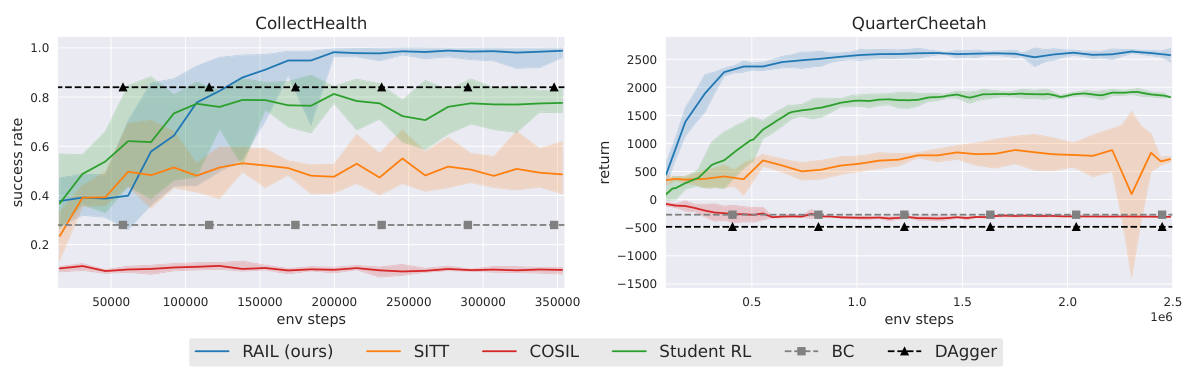
We compare student performance after transfer against behavior cloning, DAgger, COSIL, and SITT. Student RL is a reference trained directly from student observations using task rewards. Additional results and ablation studies are available in the paper.
| Method | Corners | TunnelVision | CollectHealth | QuarterCheetah |
|---|---|---|---|---|
| Behavior cloning | 24% | 12% | 28% | −268.17 ± 29.02 |
| DAgger | 38% | 15% | 84% | −484.25 ± 23.14 |
| COSIL | 28% | 0% | 8% | −308.04 ± 14.46 |
| SITT | 37% | 74% | 49% | 721.12 ± 239.63 |
| Student RL | 100% | 100% | 78% | 1,824.27 ± 30.35 |
| RAIL Ours | 100% | 100% | 98% | 2,510.24 ± 72.05 |
5 runs × 100 environment seeds. Success (%): mean with upper/lower semideviations; episodic return: mean ± standard deviation.
RAIL learns faster and reaches higher student performance than the online baselines in CollectHealth and QuarterCheetah, including Student RL trained directly on student observations with task rewards. The failure of the baselines suggests that wrong supervision can indeed degrade learning.
Zero-shot Task Transfer
After learning the representation, we freeze the encoders and train a new policy using only teacher observations on a second task. The policy is then paired with the frozen student encoder, without additional student data during adaptation.
On modified Corners, TunnelVision, and CollectHealth tasks, these policies match or surpass Student RL and perform on par with RAIL trained directly on the new task. This evaluates task transfer within the same environments and observation spaces.
BibTeX
@inproceedings{mammadov2026rail,
  title     = {RAIL: Representation-Aligned Imitation Learning
               for Student-Compatible Teacher Policies},
  author    = {Mammadov, Meraj and
               Zuidberg Dos Martires, Pedro and Stork, Johannes A.},
  booktitle = {Advances in Neural Information Processing Systems},
  year      = {2026}
}